


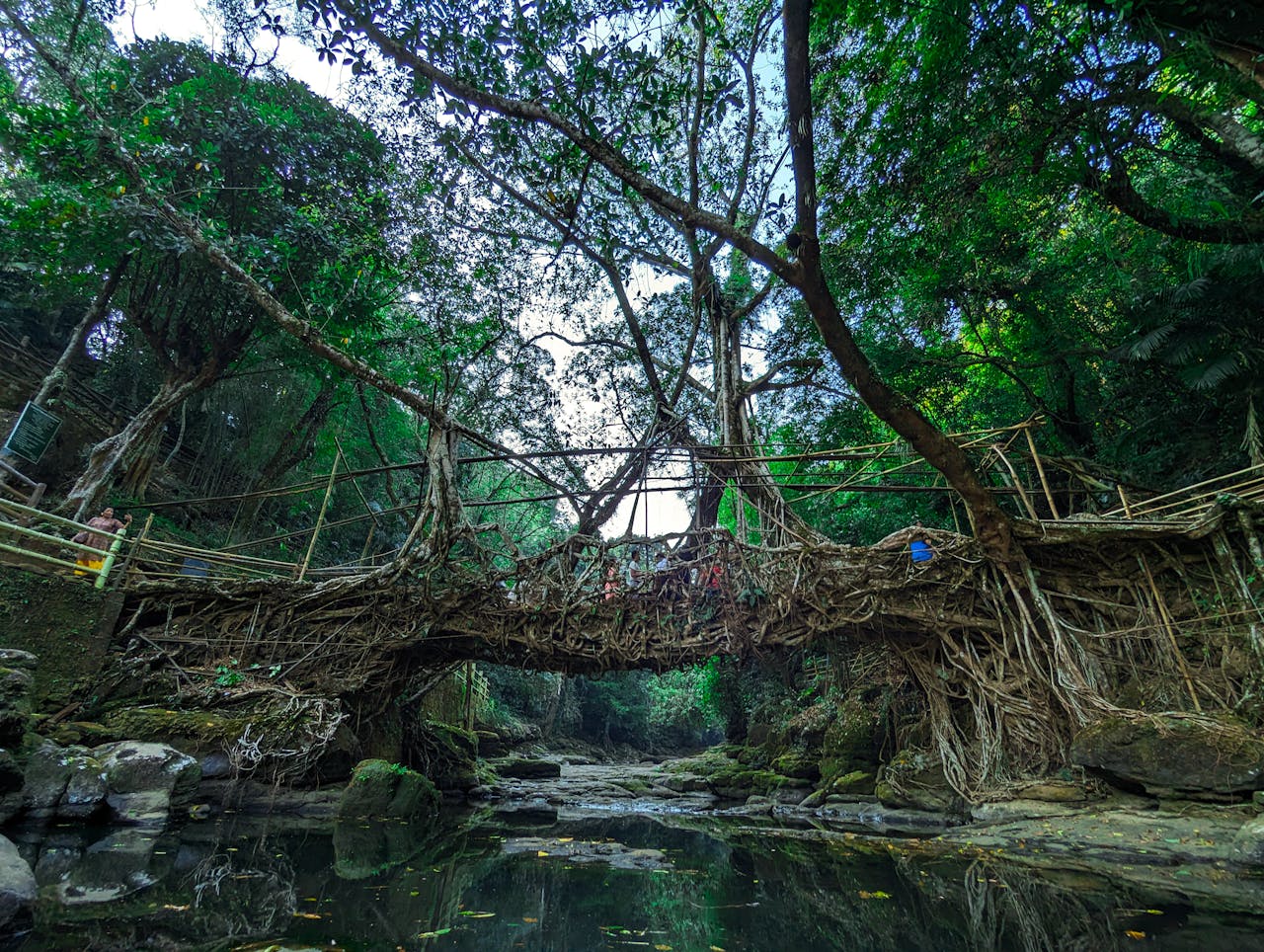
The living root bridges of Meghalaya are self-strengthening natural structures formed by training the aerial roots of Ficus elastica (rubber fig) trees across rivers and streams over decades until they intertwine into load-bearing bridges. They are a living, growing form of architecture found nowhere else on Earth, and they get stronger every year rather than weaker.
Meghalaya, the ‘Abode of Clouds,’ receives some of the highest annual rainfall on the planet. In that context, a bridge that grows more durable with every monsoon makes perfect ecological sense. This article covers what these bridges are, how they are built, why they matter globally, and what makes them genuinely unlike anything else humans have ever constructed. If you are planning some Meghalaya Tour Packages understanding these structures will transform how you experience them.
What Are the Living Root Bridges of Meghalaya?
These bridges are grown from the aerial roots of Ficus elastica trees, guided across water bodies (mostly rivers and streams) using hollow betel nut trunks or bamboo scaffolding as directional channels. They take 15 to 30 years to mature and, once fully developed, can support more than 50 people at a time. They are not decorative installations or symbolic landmarks. They are working infrastructure used daily by Khasi and Jaintia villagers to cross streams and rivers in one of the wettest regions on the planet.
The most famous examples are found in Nongriat village, Cherrapunji, and Mawlynnong. The Umshiang double-decker root bridge near Nongriat is the most celebrated specimen, two bridge levels grown one above the other, spanning roughly 30 meters. Reaching it requires descending approximately 3,500 stone steps from Tyrna village, and the trek itself is as memorable as the bridge. UNESCO has added these structures to its tentative World Heritage Site list, recognizing their global cultural and ecological significance.
How a Living Bridge Actually Grows
The process begins by splitting a hollow betel nut trunk lengthwise and using it as a channel to direct young aerial roots horizontally across a stream. Ficus elastica is specifically suited to this technique because its aerial roots are aggressive, fast-growing, and naturally seek anchor points in soil or rock. Once the roots reach the opposite bank, they are planted into the ground. Over subsequent years, additional roots are woven in to thicken and reinforce the structure, gradually creating a surface wide enough to walk across.
A usable bridge takes a minimum of 15 to 20 years. A fully mature, structurally reliable one can take 30 years or more. This is multigenerational infrastructure. A Khasi elder who begins guiding a bridge will not live to see it reach full strength. That long-term thinking, planting a bridge your grandchildren will use, is embedded in the cultural identity of these communities.
Why These Bridges Are a Masterclass in Sustainable Architecture
Conventional bridge construction requires quarrying, steel manufacturing, concrete mixing, heavy transport, and eventually demolition. A root bridge requires none of this after the initial guidance phase. The forest provides all the material. The bridge is self-repairing: if a root is damaged, the tree continues growing and fills the gap. Maintenance is largely passive.
The broader design principle here is significant. Rather than imposing an engineered structure onto a natural environment, the Khasi approach works with biological systems. The result is a structure that adapts to its surroundings, blends into the landscape, and improves over time. No concrete bridge built today will be stronger in 200 years. A mature root bridge will be.
Khasi Ingenuity: The Cultural Knowledge Behind the Bridges
There are no blueprints for these bridges. No engineering manuals. The knowledge is entirely oral and intergenerational, passed from elders to children over centuries within Khasi and Jaintia communities. The bridges are cultural artifacts as much as they are infrastructure, symbols of a community’s relationship with the forest and their capacity for long-term thinking in an era that rarely rewards it.
Modernization and migration are creating real knowledge-preservation challenges, which is one reason UNESCO recognition matters beyond tourism.
3 Things People Get Wrong About Living Root Bridges
Common misconceptions worth correcting before you visit:
- They are fragile or decorative. Mature bridges have held 50+ people at a time and have survived centuries of extreme monsoon conditions. They are among the most durable structures in the region.
- They are a recent eco-tourism invention. These bridges predate modern tourism by centuries. They were built out of necessity by communities who needed reliable river crossings and not as tourist attractions.
- Any tree can be used. Ficus elastica’s specific root behavior—aggressive, anchor-seeking, and fast-growing— is what makes this technique work. Attempts to replicate it with other species have largely failed.
Plan Your Visit to the Living Root Bridges of Meghalaya
The best time to visit is October through May. Post-monsoon months bring vivid green landscapes and full waterfalls without the extreme rainfall that makes trails genuinely hazardous. The trek to Nongriat and the double-decker bridge involves a steep descent of roughly 3,500 steps each way, so honest physical preparation matters. It is demanding, but the experience of standing on a living bridge above an emerald pool in the Meghalaya hills is worth every step.
Some Offbeat Meghalaya Group Trip include guided treks to Nongriat and the double-decker bridge, with experienced local guides who bring the cultural and ecological context to life. If the living root bridges of Meghalaya are on your travel list, a well-planned group trip ensures you see them properly, not just as a photo stop, but as the architectural and cultural wonder they genuinely are.