
Updated: Aug 2026
Canada is home to two spectacular Notre-Dame churches: Notre-Dame Cathedral Basilica in Ottawa and Notre-Dame Basilica in Montreal. I visited both on the same trip, and while they share their Gothic Revival heritage, the experience of stepping inside each is completely different.
Maybe it’s the Goan blood, but I have a thing for churches.
Notre-Dame Cathedral Basilica Ottawa & Notre-Dame Basilica Montreal
On my trip to Canada, two of them stopped me in my tracks. They were so stunning, so magnificent, that I gave up taking pictures partway through – nothing I captured came close to standing there in person. I sat down to write about them and genuinely didn’t know where to start. So here’s my best attempt at describing two of Canada’s most breathtaking churches: the Notre-Dame Cathedral Basilica in Ottawa, and the Notre-Dame Basilica in Montreal.
Notre-Dame is French for “Our Lady,” referring to the Blessed Virgin Mary – which is why you’ll find churches with this name all over the French-speaking world. These two in Canada are entirely separate churches: Ottawa’s is both a cathedral and a basilica, while Montreal’s is a basilica.
Notre Dame Cathedral, Ottawa: History and What to See
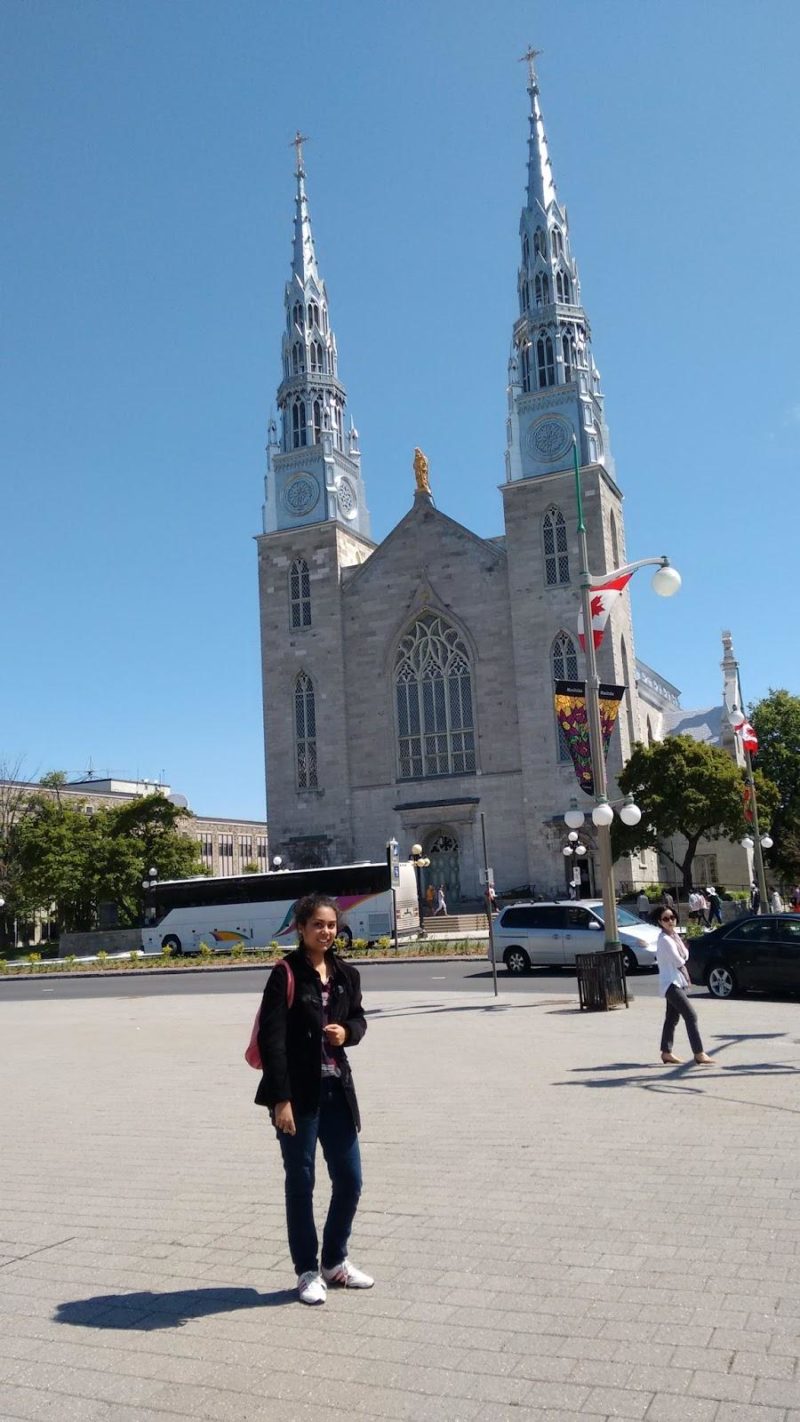
If you are walking around Ottawa, the twin spires of Notre-Dame Cathedral Basilica are hard to miss.
The church was first planned in 1839 as a parish church, when Ottawa was still Bytown, a small frontier lumber town. Its design changed considerably during construction, moving from the original Neoclassical plan towards the French Gothic Revival style we see today. It became the cathedral of the Diocese of Bytown in 1847 and was elevated to basilica status in 1879. Parks Canada designated it a National Historic Site in 1990.
But enough history. Walk inside. That is when it gets really interesting.
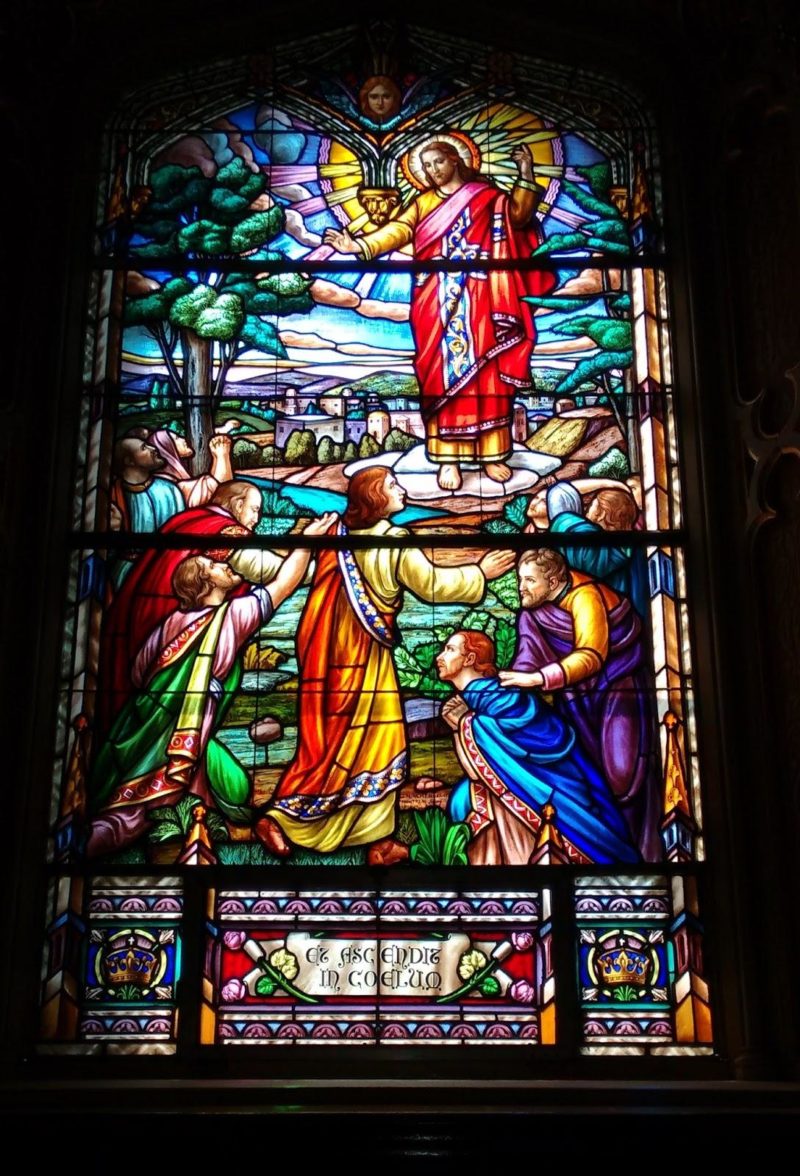
There’s no doubt that visitors must have been struck by the majesty of this place generations ago, and I was no different.
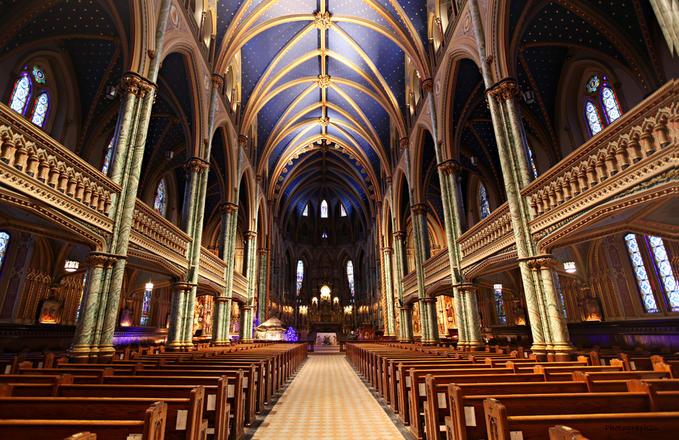
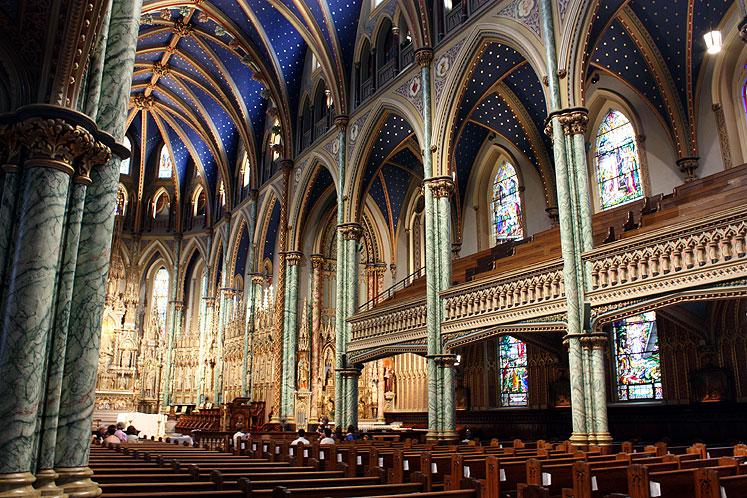
The soaring arches, terraced galleries, stained-glass windows and mysterious blue lighting had me looking everywhere at once. The interior is an extraordinary combination of Gothic Revival architecture, French-Canadian church traditions and classical elements. The ceiling is painted a deep blue and decorated with gold stars, while the sanctuary and apse are filled with elaborate carving, gilding, statues and colour.
As you walk down the centre, you are flanked by slender stone columns separating the aisles from the seating area. The arches progressively open up to reveal stained-glass windows depicting biblical scenes.
Then look up. The blue ceiling stretches above you, covered in gold detailing, and your eyes are naturally drawn towards the sanctuary and the ornate crown above the main altar. It is theatrical without feeling gaudy.
And then there is the altar.
I’ve never seen detailing quite like what’s on the bronze altar — carved with scenes from the birth and resurrection of Christ, and his teachings. The sanctuary around it is rich with Gothic adornments and sculptures of biblical figures, including St. Joseph, patron saint of Canada, along with St. John the Baptist and St. Patrick, patron saints of Ottawa. The lateral altars are made of wood, covered in gold leaf, and studded with jewels.
The basilica’s stained glass deserves a closer look too. Some of the original windows were replaced between 1956 and 1961 with a series of 17 windows by Canadian-Italian artist Guido Nincheri depicting the lives of Jesus and Mary.
Oh, and look out for the organ. That’s something I didn’t know when I visited – I read about it later. Notre-Dame Cathedral Basilica is home to a remarkable Casavant organ with 4,700 pipes, 96 ranks and 72 stops spread across its main and sanctuary organs. The instrument has undergone several renovations over the years, including a major restoration in 1999. So if you happen to visit when the organ is being played, don’t rush out.
Visiting Notre-Dame Cathedral Basilica in Ottawa in 2026?
There is no admission fee to visit the cathedral.
The church remains an active place of worship, so if you’re a tourist, remember that this isn’t simply a tourist attraction. Dress and behave appropriately, and check before taking photographs during services.
The Cathedral is open every day for private prayer and visitation, although visitor access can change at short notice because of weddings, funerals and other liturgical celebrations. Current hours are 9am-6pm Monday to Friday and 9am-7pm Saturday and Sunday. Sunday Masses are held at 10am in French, 12pm in English and 5pm bilingually. Check the Cathedral’s website before visiting for the latest schedule.
Visitor hours can be more restrictive than you’d expect, sometimes limited to just a couple of half-hour windows in a day depending on scheduled services and events.
One very important 2026 update: the main entrances on Sussex Street have been temporarily closed for renovation since April 30, 2026. The cathedral is currently directing visitors to side entrances on St. Patrick Street and Guigues Avenue. Check the cathedral’s current visitor information before you go because access may change as the work progresses.
The location is also excellent for sightseeing. You can easily combine a visit with Parliament Hill, the ByWard Market, the National Gallery of Canada and the Ottawa River. It’s a pleasant 10 – 15 minute walk from Parliament Hill, taking you past a good stretch of the city’s architecture along the way. Several OC Transpo bus routes stop nearby too. If you’re driving, know that downtown parking can be both scarce and pricey – walking or transit is genuinely the better call here.
Guided tours are available for those who want one – tickets run $10 per person for ages 13 and up, purchased from Café des Tours in the church’s basement, and tours run 45 minutes to an hour. Entry to simply visit and wander is free of charge.
Notre Dame Basilica, Montreal: The Other Notre Dame Church
If the Ottawa cathedral impressed me, Notre-Dame Basilica in Montreal completely floored me.
It has a similar Gothic Revival sensibility, but the interiors are much more theatrical. Hundreds of thousands of visitors come to see Montreal’s most famous church, and when you step inside, it is easy to understand why.
The first thing that struck me was the sheer amount of detail. Wood, paintings, gilded sculptures, deep blues, intricate carvings and stained glass seem to compete for your attention.
You look at one thing and then notice something else behind it. And then something above that. My jaw was on the floor!!
The exterior is relatively restrained compared with what awaits inside. The interior decoration was substantially redesigned in the 19th century by Montreal architect Victor Bourgeau, drawing inspiration from places such as Sainte-Chapelle in Paris, with extensive use of colour and gold-leaf decoration.
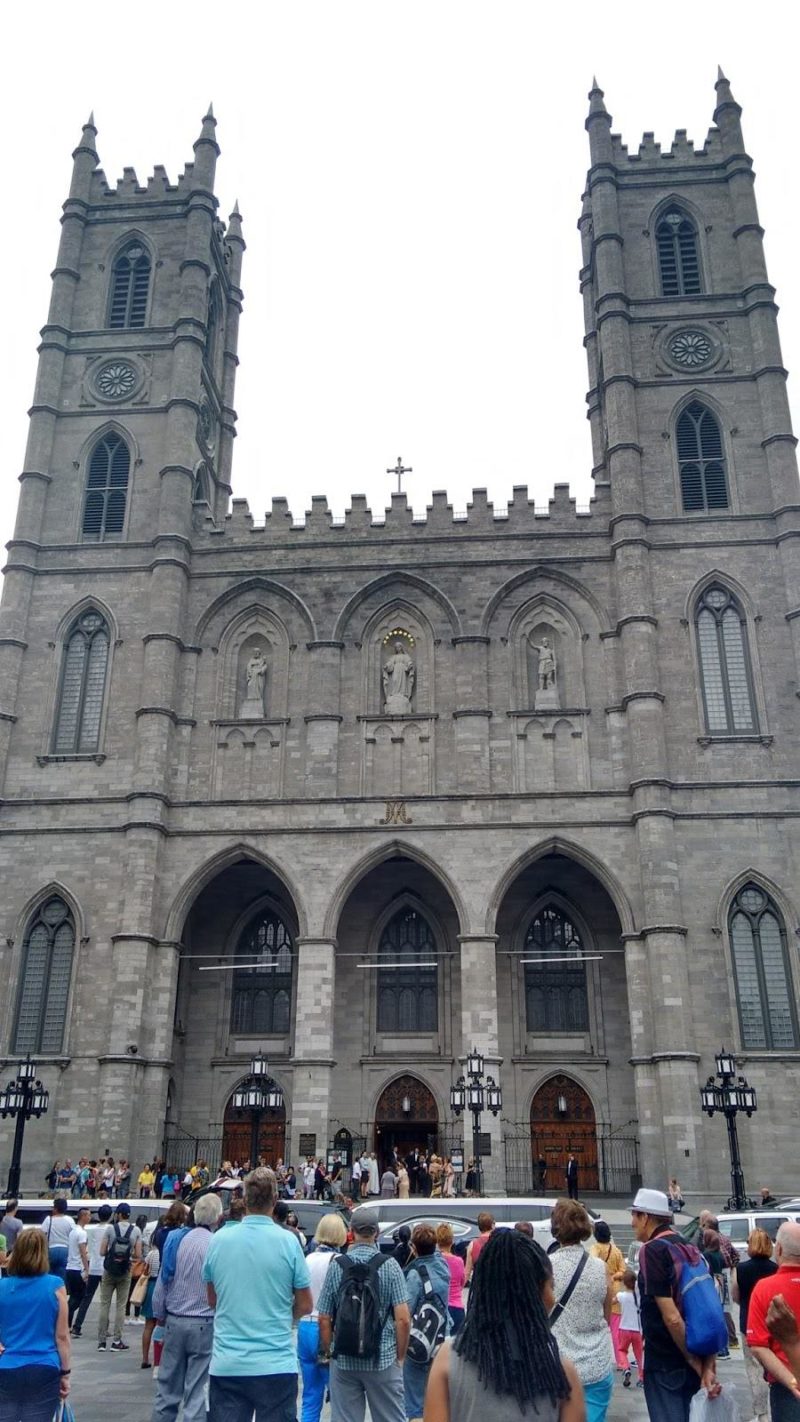
A surprisingly fascinating history
The current Basilica was built between 1824 and 1829, although its two towers were completed later, in 1841 and 1843. It was designed by James O’Donnell, an Irish-born architect from New York who was Protestant when he was commissioned to design the church.
Here’s the interesting bit: O’Donnell later converted to Catholicism and was buried in a crypt beneath the Basilica after his death in 1830.
The Basilica was the first Gothic Revival church in Canada and was, for a time, the largest place of worship in North America. It was elevated to the rank of minor basilica by Pope John Paul II in 1982 and designated a National Historic Site of Canada in 1989. So when you walk in, you’re not just looking at a pretty church. You’re looking at almost two centuries of Montreal’s history.
The Celine Dion connection
The Basilica has also hosted some rather famous occasions.
Celine Dion and René Angélil were married here on December 17, 1994, in a ceremony attended by 500 guests. Celine’s son, René-Charles, was also baptised in the Basilica’s Sacred Heart Chapel in 2001.
The Basilica has also hosted important state funerals, concerts and other significant religious and cultural events. So yes, when you’re standing there looking at that enormous blue ceiling, you can add “Celine Dion got married here” to the list of things running through your head.
The Sacred Heart Chapel
There’s another part of the Basilica that deserves a mention: the Notre-Dame du Sacré-Cœur Chapel, also known as the Sacred Heart Chapel.
It was built in 1891 for smaller ceremonies such as weddings and funerals, but was seriously damaged by a fire in 1978. It was subsequently rebuilt, incorporating traditional craftsmanship alongside contemporary elements. The reconstructed chapel includes a huge bronze altarpiece by sculptor Charles Daudelin, measuring more than 15 metres high. The chapel reopened in 1982 and is now used for adoration, meditation and weddings.
I only had five minutes to zoom through the entire Basilica because my tour bus was leaving.
Five minutes.
Although, honestly, even hours would probably not have been enough.
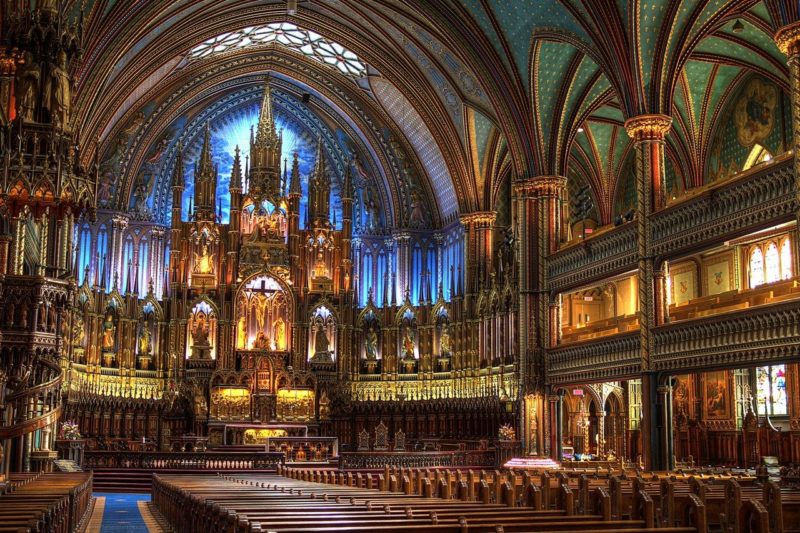
Notre-Dame Basilica, Montreal by Day – and by Night
Today, you can experience the Basilica in two very different ways.
During the day, there are sightseeing visits where you can explore the architecture, history and religious heritage of the building.
And then there is AURA.
AURA is an immersive nighttime light-and-music experience created by Moment Factory, using the Basilica’s architecture, stained glass and soaring ceilings as its canvas. The experience lasts around 40–45 minutes and lets you see the Basilica in an entirely different way. There is also a combination ticket that pairs the daytime sightseeing visit with AURA, which is a good option if you want to experience both sides of the Basilica. Check the schedule and book ahead, particularly during busy periods.
So if you’re visiting Montreal now, you don’t necessarily have to choose between seeing the Basilica as a historic church and experiencing it as a piece of contemporary art. You can do both!
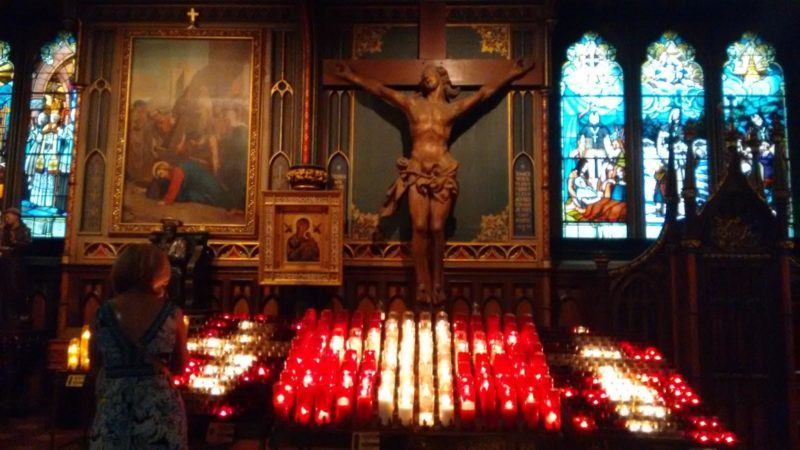
The Basilica Is Still Being Restored
Another important update if you’re planning a visit in 2026: Notre-Dame Basilica is undergoing a major, long-term restoration programme.
The work began in 2020 and involves extensive restoration of the building’s exterior and stonework. More than 2,000 stones had to be replaced during restoration of the west tower alone.
The restoration programme is expected to continue for many years, so it’s worth checking the Basilica’s current visitor information before your trip. Some exterior elements may look different from the photographs you see online.
The good news is that the restoration is about preserving this extraordinary building for the future rather than changing what makes it special.
Notre-Dame Cathedral Ottawa vs Notre-Dame Basilica Montreal
So which one is more beautiful? This is where I refuse to be diplomatic.
Montreal wins for sheer drama.
Ottawa’s cathedral is elegant, intricate and incredibly impressive. I loved the blue-and-gold ceiling, the arches, the stained glass and the elaborate sanctuary. But Montreal’s Basilica felt like someone had taken all those elements and turned the volume up.
There is more colour. More gold. More visual drama. More detail competing for your attention.
Tips for Visiting the Notre-Dame Cathedrals
1. Check for weddings and services
There are ALWAYS weddings and religious services at churches like these. Find out what is happening before you go because access can be restricted during ceremonies.
2. Give yourself time
Don’t make the mistake I did in Montreal. I had five minutes.
Five.
I walked through trying to absorb an entire architectural masterpiece before my tour bus left. You need more time than that.
3. Be respectful about photographs
There is no fee to attend a church service, but if you’re visiting as a tourist, remember that this is still a functioning place of worship. If a service is taking place, put the camera away. There will be plenty of time to photograph the details when visitors are permitted to do so.
4. Look up
Seriously. The best details are not necessarily at eye level. Look at the ceilings, arches, stained glass, sculptures, columns and the tiny decorative elements that you might otherwise walk straight past.
5. Check current opening information
Churches are not museums with perfectly predictable tourist hours. Services, weddings, events and restoration work can affect access.
For Ottawa, check the cathedral’s current visitor information before going, particularly because of the 2026 entrance renovations.
For Montreal, check the current sightseeing schedule and ticket information before visiting. The Basilica is an active church as well as a heritage attraction.
6. Sunday mornings are for Mass, not sightseeing
Tourist visits don’t start until 12:30pm on Sundays. If you show up earlier expecting to wander and take photos, you’ll be standing on the steps waiting.
7. Dress code is enforced.
Shoulders and knees need to be covered to enter. People do get turned away for this, so plan your outfit with that in mind.
That’s a wrap! If you like churches, read my blog on the churches in Pondicherry, a former French colony in India and this one abut this supposedly haunted church in Goa!
