
Updated: Aug 2026
Quebec, like a child of mixed parentage, has features of Europe and Canada, with her own distinct French personality. She takes you back to a time when people still valued the art of conversation, sat at laughter-filled coffee shops that spilled onto cobbled streets, and worshipped in churches that seemed to belong to another century.
My days here were like a stone being skipped happily across water.
Time just slipped through my fingers and the days passed by as quickly as the stone took its next leap forward.
It was only four days, after all, and we had to make the absolute most of it. Plus, when you’re on a sightseeing tour with a couple of dozen other people, there is a schedule to be stuck to. We did manage to sneak away occasionally to explore the unexplored, which inevitably left us with less time for both the exploring and the time-bound itinerary.
One of those excursions took us to Sainte-Anne-de-Beaupré, about 35 kilometres east of Quebec City, to visit its famous basilica and shrine.
The Basilica of Sainte-Anne-de-Beaupré is one of Canada’s best-known pilgrimage sites. The story of the shrine goes all the way back to 1658, when the first chapel was built here. More than 350 years later, people still come here to pray, light candles, leave petitions and seek the intercession of Saint Anne.
But before we reached the basilica, there was a canyon to conquer.
Canyon Sainte-Anne
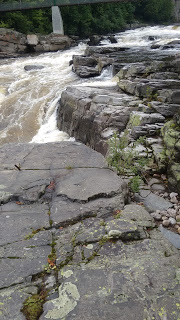
Before heading to the shrine, we stopped at Canyon Sainte-Anne, a spectacular gorge carved through rock that dates back roughly 1.2 billion years.
The short trek took us along the falls and across the gorge on suspension bridges of various heights.
Both sides of the path were lined with lush, dense foliage, still glistening with rain from the morning’s drizzle. Apart from the rumble of the waterfall below and the twittering of birds overhead, there was silence.
The trail went on, first uphill and then down, turning and twisting its way around the canyon.
The last of the three bridges was the one closest to the rapids. To get there, we had to walk down exactly 187 steps.
At the bottom, we were met with a long, shaky wooden bridge.
It would have been amazing to zipline across the falls.
But hey, when you have a bouncy bridge ahead of you, you jump!
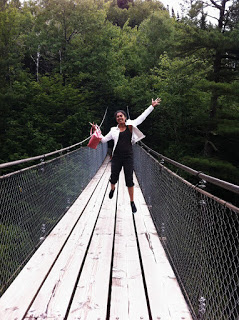
The walk back up the steps was easy at first, and then every step became more painful than the last. After puffing, panting, wailing and taking countless “five-minute” breaks, we finally made it to the top..
Only to discover that we had to walk uphill and downhill all over again to get back to the vehicle and leave for the shrine.
By the time we arrived at Sainte-Anne-de-Beaupré, my legs were not exactly prepared for another adventure.
Fortunately, this one involved considerably less climbing.
The Basilica of Sainte-Anne-de-Beaupré
The Basilica of Sainte-Anne-de-Beaupré is one of Quebec’s priceless treasures. From the outside, it is imposing. Inside, it is something else altogether. The present basilica is built in the Romanesque Revival style and is shaped like a cross. It stretches about 100 metres in length and is filled with paintings, mosaics, stained glass, stone sculptures and woodwork.
But numbers and architectural descriptions don’t really prepare you for what it feels like to walk through those doors.
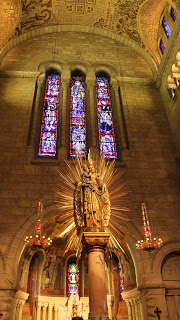
The interiors were warmly lit and gave out a soft, golden glow. Every inch of the ceiling seemed to be covered with paintings and intricate detail, so fine and regal that it was impossible to believe it had all been done by people working from scaffolding high above the floor.
The basilica seemed sombre at first, but it captivated every sense from the moment I walked in.
You could hear the mutter of prayers.
Smell the smoke wafting up from burning candles.
See rows upon rows of people kneeling quietly, writing petitions on little pieces of paper before walking up to the statue of Saint Anne and placing them in a box.
And suddenly, this wasn’t simply another stop on a sightseeing itinerary.
Why is Sainte-Anne-de-Beaupré famous?
The shrine is dedicated to Saint Anne, the mother of the Virgin Mary and grandmother of Jesus, and is known for its long history of pilgrimage, reported healings and favours received through her intercession.
The story of Louis Guimont is one of the best-known stories associated with the shrine. Guimont was involved in building the first chapel and, according to the shrine’s tradition, suffered from a serious physical ailment, rheumatism. After praying to Saint Anne and placing three stones on the foundation of the church, he was reportedly healed.
Stories of healings like this helped establish Sainte-Anne-de-Beaupré as a place of pilgrimage. Today, thousands of visitors continue to come here, many hoping that their own prayers will be answered.. You don’t have to look very hard to see how deeply that tradition has shaped the place. Crutches, canes and braces left by pilgrims are displayed at the shrine as reminders of favours and healings people believe they have received.
Whether you arrive as a believer, a curious traveller, or simply someone who appreciates beautiful old buildings, it is difficult not to pause and take it all in.
The story behind the miraculous shrine
There is something fascinating about the way faith and history have become intertwined here.
As devotion to Saint Anne grew, so did the number of pilgrims arriving at the site. Several churches followed over the centuries before the present basilica was built. The basilica was badly damaged by fire in 1922, but not everything was lost. The statue of Saint Anne that now sits high on the facade was rescued from the fire.
Today, the sanctuary extends beyond the basilica itself. There is Saint Anne’s Fountain, the Memorial Chapel, the Scala Santa, the Way of the Cross, chapels, relics and numerous works of religious art spread throughout the grounds.
So if you visit, don’t simply walk into the basilica, take a few photographs and leave.
There is much more to see.
What to see inside the Basilica of Sainte-Anne-de-Beaupré
Walking around the basilica, I found myself looking up almost as much as I looked ahead. Light from the stained-glass windows spilled across the ceiling, while candle flames cast shadows over the mosaic, marble and stone. There was something almost theatrical about it, except this wasn’t a performance. People were here to pray.
The ceiling mosaics
The ceiling was one of the first things that caught my attention. The mosaics tell the story of Saint Anne’s life, with the imagery culminating above the main altar, where Saint Anne, the Virgin Mary and the infant Jesus appear together.
Look up. Then look up again. There is an astonishing amount of detail overhead, and it is the sort of place where you can stand in one spot for several minutes and still notice something you missed the first time.
The copper doors
The entrance doors deserve a proper look before you even step inside. The handmade copper doors depict scenes from the life of Jesus and were created by Quebec sculptor Albert Gilles. According to the shrine, the three sets of double doors took 12 months of work and were originally installed at St. Joseph Church in Quebec City before being transferred to Sainte-Anne-de-Beaupré in 2003.
I remember being struck by them because they weren’t merely functional doors. They were works of art. Read more about Albert Gilles copper art and participate in a epoussé workshop workshop here!
The Pietà
I came across the Pietà while wandering around the basilica and stopped for longer than I expected.
It is a replica of Michelangelo’s famous Pietà. There was something about seeing it in that setting – surrounded by prayer, candlelight and silence – that made it feel very different from encountering a replica simply as an art object. I stood there looking at it for a while. It is one of those moments from a trip that stays with you.
The ambulatory
A circular passage runs behind the altar and comes out on the other side. I followed it around, passing stained-glass windows and statues of saints along the way. The light coming through the glass changed the mood of the space completely.
The underground chapel
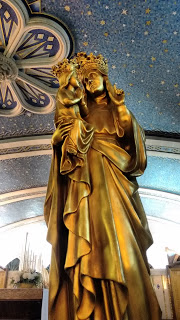
Stairs lead down to a wide underground chapel that felt almost like a completely different church. It was relatively empty when I visited, with a golden statue of Mary beside the altar. White, frilly patterns criss-crossed the ceiling, breaking up alternating star and floral designs all the way to the front altar. After the grandeur upstairs, the chapel felt quieter and more intimate.
The Scala Santa and Way of the Cross
The basilica complex has several other places worth seeing beyond the main church.
The Scala Santa, or Holy Stairs, is a staircase inspired by the steps Jesus is traditionally believed to have climbed on the way to Pilate’s praetorium. It is a reminder of the Passion of Christ.
There is also a Way of the Cross on the hill behind the basilica, with 14 stations depicting moments from the Passion of Jesus.
If you have the time, walk around the grounds too.
The Memorial Chapel commemorates an earlier church on the site, while Saint Anne’s Fountain stands in front of the basilica. The shrine also houses three notable relics associated with Saint Anne.
Sainte-Anne-de-Beaupré from Quebec City
If you’re staying in Quebec City, Sainte-Anne-de-Beaupré makes for an easy excursion. The shrine is about 35 kilometres east of Quebec City, along the St. Lawrence River. The Côte-de-Beaupré region is worth exploring in its own right, so I wouldn’t necessarily make the basilica a quick in-and-out stop.
You can combine a visit to the basilica with other attractions in the region, including Montmorency Falls and Canyon Sainte-Anne.
That’s essentially what we did, and it made for a much more interesting day.
If you’re planning a Quebec City itinerary, I’d therefore look at Sainte-Anne-de-Beaupré as part of a larger Côte-de-Beaupré day trip rather than as a standalone attraction.
Is the Basilica of Sainte-Anne-de-Beaupré worth visiting?
Yes. And I say that even if you’re not particularly religious.
The Basilica of Sainte-Anne-de-Beaupré is beautiful, but beauty isn’t really the reason I remember it.
It’s the atmosphere. It’s the people quietly kneeling in prayer. It’s the candles. It’s the handwritten petitions. It’s the crutches and canes. It’s the feeling that, for the people who come here, this isn’t simply an old building or another attraction to tick off a sightseeing list.
There is real faith here. And that changes the way you experience the place.
Walking around the basilica is like walking into a fairy tale. Light from the stained-glass windows spills across the ceiling, while dancing candle flames cast shadows over the mosaic, marble and stone.
More than spectacular architecture, intricate mosaics and polished sculpture, this place is steeped in history. Prayer mingles with the smoke of a thousand candles and makes its way upwards. That’s what makes Sainte-Anne-de-Beaupré more than just another tourist attraction.
My little prayer at Sainte-Anne-de-Beaupré
After admiring the ornate ceiling and feasting my eyes on the glittering gold statue of Saint Anne, I made my way to a pew and wrote down petition after petition.
I finished, walked up to the statue and knelt with a dozen others around its base. Tied to the armrest was a printed prayer to be said before placing your note into the box. I said the prayer. Then stuffed my wad of paper into the box. And wandered around some more. I don’t know if miracles work according to schedules. Perhaps that’s the point.
When I’m in Goa, I often visit a St. Anne’s Chapel a couple of minutes away from my house to attend Konkani Mass on Sunday.
So the next time I’m home, I’ll be sure to follow up with Her on my miracle.
It will probably come my way when the time is right.
Basilica of Sainte-Anne-de-Beaupré: Visitor Information
Address: 10018 Avenue Royale, Sainte-Anne-de-Beaupré, Quebec, Canada.
Distance from Quebec City: Approximately 35 km east of Quebec City.
Basilica hours: The current schedule lists the basilica as open from 8:00 a.m. to 7:00 p.m. Monday to Saturday, and 7:30 a.m. to 7:00 p.m. on Sunday. Individual chapels and facilities have different hours.
Mass: Mass is celebrated throughout the week, with the schedule changing seasonally. Check the shrine’s current Mass schedule if you want to attend a service.
Accessibility: The shrine lists the site as accessible for people with reduced mobility.
How long should you spend here? I’d say at least a couple of hours if you want to properly see the basilica and the surrounding shrine grounds rather than simply photograph the facade.
What can you combine it with? Canyon Sainte-Anne and Montmorency Falls are natural additions to a Côte-de-Beaupré day trip.
A note before you go: Hours, Mass schedules and seasonal activities can change, so check the official shrine website before visiting.
Before you go, check out my blog posts on Niagara Falls and the different markets you can visit in Toronto.

Great comprehensive read, it’s like I was there sharing the experience.
Author
Yaay, glad to hear that, David! That’s what I aim for!
My oldest daughter, now 36, went on a grade 8 trip from Southern Ontario to st. Anne’ Bascilla. I was blessed to go as chaperone. A long bus ride but ihave never forgotten the first site of the cathedral. We are not catholic however, I did the “stations of the cross” on my knees, was amazed by the history of healing, awed by the beauty and emotionally overcome by David’s replica. Was as if he were alive. Amazing.
The canyon and falls were incredibly beautiful even tho I couldn’t force myself to take the suspension bridge (the bus had to wait for me to walk all the way around) I came home with conviction (+ few bottles of honey wine) that my husband and I would return. Life gets busy and time passes. He died peacefully in his sleep, age 56 in August “22, he had many health issues bur was an amazing man, we were 3 weeks from our 35th anniversary. In his memory I will be returning. The beauty and overwhelming feeling of being in God’s presence there has never left my soul,