
Little India is one of those parts of Singapore that you shouldn’t save for a quick tick-off-the-list stop.
You can, of course, walk through it in an hour, take a photograph of the rainbow-coloured shophouse, eat a dosa and declare the neighbourhood done. But you’ll miss the point completely. I think Little India is best experienced slowly, preferably when you’re hungry.
Start at Tekka Centre and you’ll find a wet market selling fresh produce, meat and fish, alongside hawker stalls and food shops. Walk down Serangoon Road and see how the scenery changes every few metres: gold jewellery shops, sari stores, flower garlands, Hindu temples, spice shops, restaurants and old shophouses squeezed alongside newer cafes and businesses. Somewhere in between, you’ll probably find yourself buying something you hadn’t planned to buy. But that’s part of the fun.
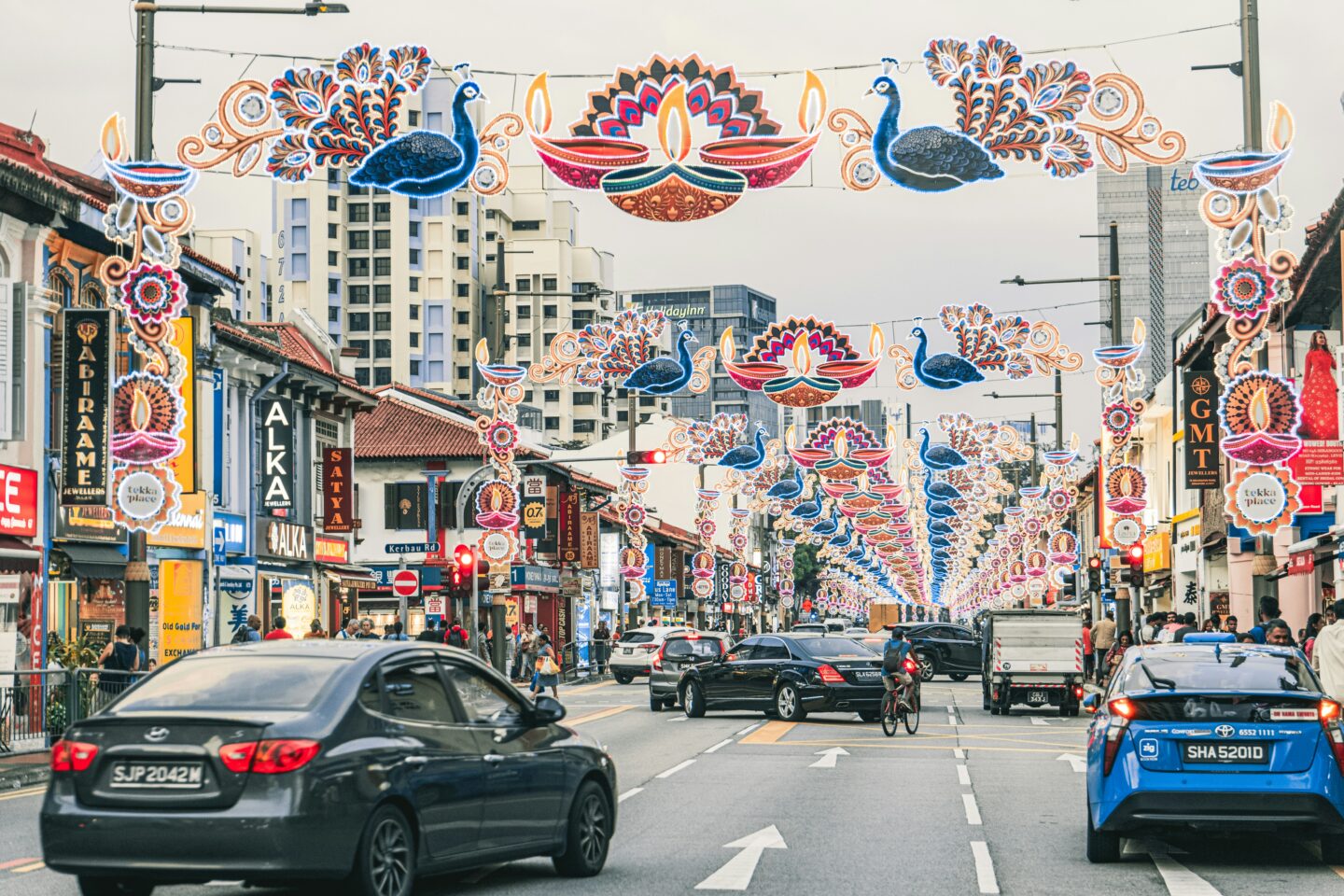
This is one of Singapore’s oldest and most established Indian neighbourhoods, with commercial activity along Serangoon Road dating back to the early 19th century. The area grew alongside the cattle trade and eventually became a centre for Indian commerce, food, religion and community life.
And while Singapore has polished its way into being one of the world’s easiest cities to navigate, Little India still feels wonderfully busy, layered and lived-in. I actually stayed in Little India for over 2 weeks – so I have a fair idea of what you should spend your time doing. For more of my recommendations in Singapore, read my Singapore Travel Guide.
Where is Little India in Singapore?
Little India is just north of Singapore’s downtown core, around Serangoon Road, Race Course Road, Buffalo Road, Campbell Lane, Dunlop Street and the surrounding lanes.
The easiest way to get there is the Little India MRT Station, served by both the North East Line and Downtown Line. You can also arrive at Farrer Park or Rochor MRT and walk into the neighbourhood. If it’s your first visit, get off at Little India MRT and start around Tekka Centre. From there, most of the places worth seeing are comfortably walkable.
Little India is not huge. You don’t need to spend the day commuting between attractions. Give yourself 3–4 hours if you want to eat, wander, shop and actually look around.
Things to See & Do in Little India
1. Start at Tekka Centre
If you only have time for one place in Little India, make it Tekka Centre. If you have time, you can still start here and immediately set off in search of the pretty shophouses.
Tekka is part wet market, part hawker centre and part neighbourhood institution. The present building dates to 1982, when the market was relocated from its earlier site across the road. The original market had been around since 1915. The ground floor is where you get the market experience: vegetables, meat, fish, spices, dried goods and all the things that make a market considerably more interesting than a carefully arranged supermarket aisle.
Upstairs is where you’ll want to eat. Walk around first, look at what people are ordering. Look at what has a queue and look at the plates going past you. There is plenty of biryani, dosa, prata, Indian-Muslim food and other inexpensive eats – which is rare by Singapore standards. Hey, don’t think cheap is uninteresting! Some of the best food experiences in Singapore are still served from places where you’re more concerned about finding an empty chair than appreciating the interiors.
If you enjoy experiencing hawker markets in Singapore, I’ve listed all the worthwhile ones to visit in another blog post that I’ll link here.
2. Walk Serangoon Road
Once you’ve eaten, or sensibly decided to eat again later — walk along Serangoon Road. This is the main artery of Little India and has been at the centre of commercial activity here for well over a century. In fact, an 1828 map referred to it as the road “leading across the island”.
This is the part of Little India where I think it’s worth putting the phone away occasionally. Look at the shopfronts, the flower garlands, the stacks of spices, the gold jewellery, the sari shops, the old five-foot ways beneath the shophouses, the temples tucked between businesses. And also look at the completely ordinary things happening around them.
That’s what makes Little India more interesting than a neighbourhood that has simply been preserved for tourists. It is still a functioning commercial and community district. Many of the longstanding businesses here – flower shops, textile merchants, restaurants, meat suppliers and spice businesses — have served generations of customers.
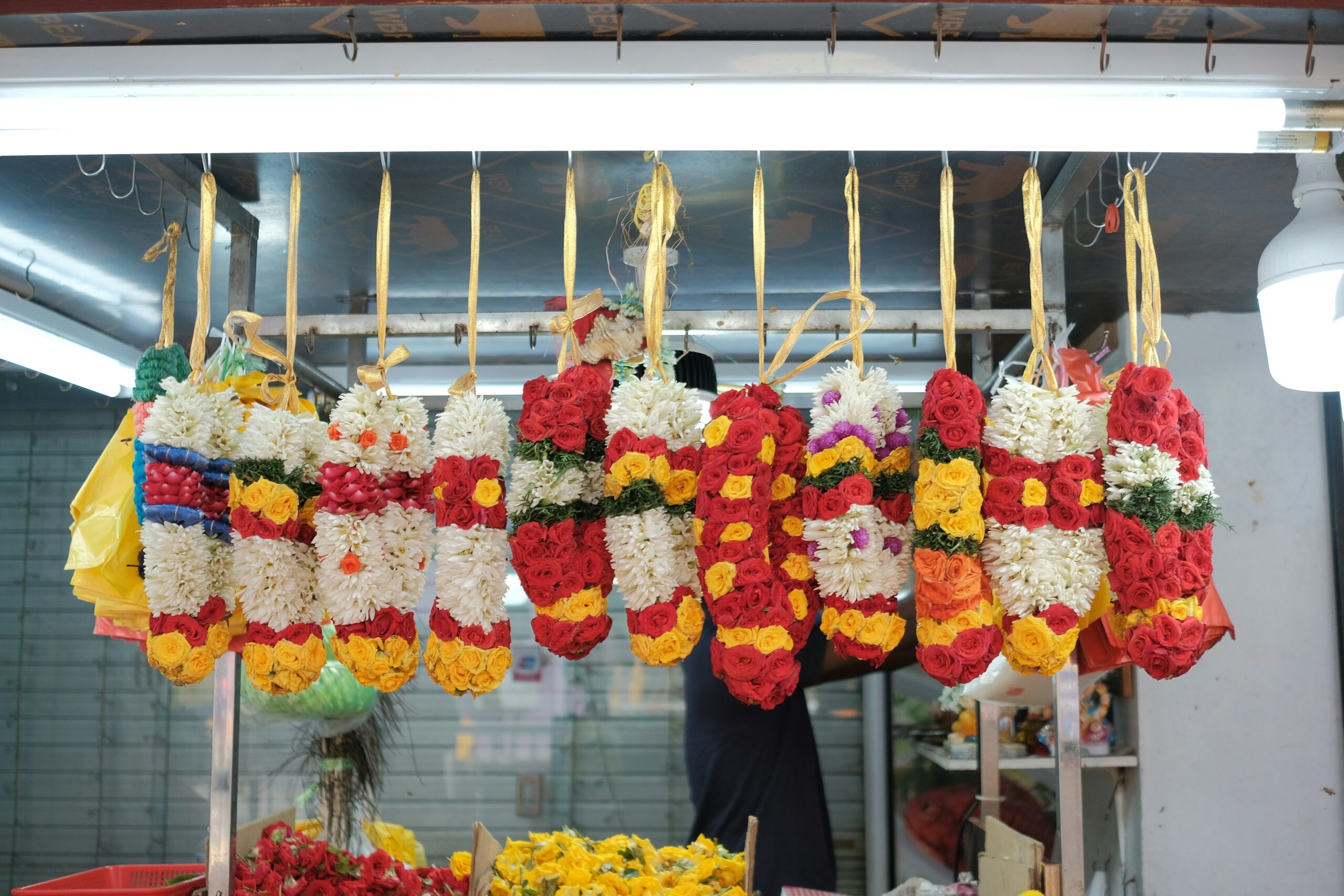
3. See the flower garlands being made
If you’re Indian, watching flower garlands being made probably won’t sound very exotic. But it is one of my favourite things to observe in Little India. You’ll see them outside shops and temples, often made from jasmine and other brightly coloured flowers.
I found it interesting to learn that garland-making is one of the traditional trades that still survives in the precinct. Anushia Flower Shop on Kerbau Road is one of the remaining local garland makers, while Jothi Store & Flower Shop has been part of Little India’s commercial life since 1960. It goes without saying that the smells as you walk by are wonderful!
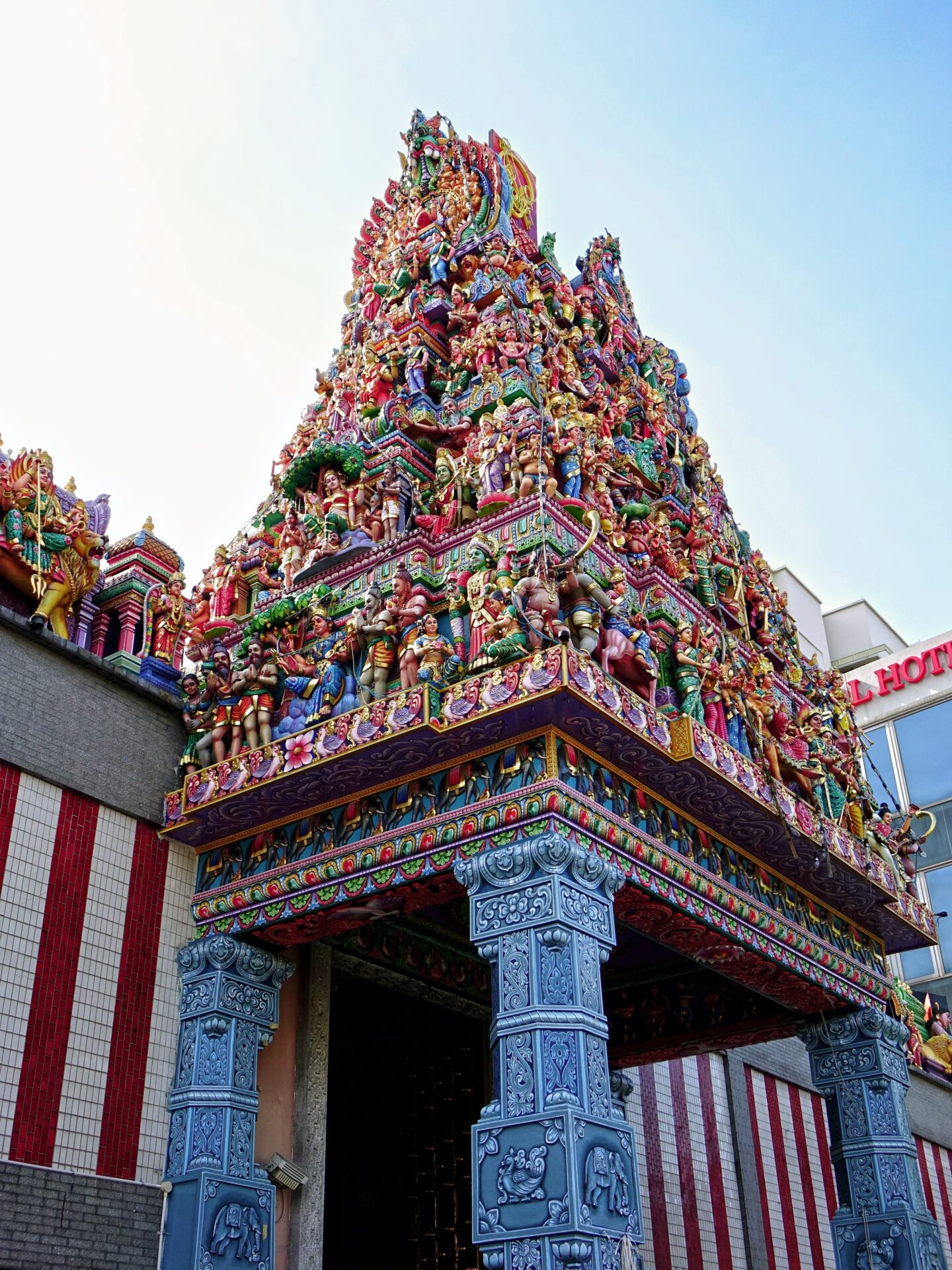
4. Visit Sri Veeramakaliamman Temple
It’s worth going inside rather than stopping outside for the obligatory photograph. But remember that this is an active place of worship, not a museum attraction. Dress respectfully, remove your shoes where required and be mindful of people who are there to pray. The temple is particularly striking when you see the contrast between its elaborate architecture and the busy commercial road outside. This temple reminded me of the Sri Kailawasanathan Swami Devasthanam Kovil in Colombo, Sri Lanka. Its colourful, sculpture-covered gopuram and elaborate detailing belong to the South Indian Dravidian tradition that travelled with Tamil communities across the region and the similarities between Tamil Nadu, Sri Lanka and Singapore are interesting.
Tip: check current timings before making this a fixed stop in your itinerary. Religious sites can have breaks in opening hours, and current listings show morning and evening visiting periods rather than one continuous opening window.
5. See Sri Srinivasa Perumal Temple
If you enjoy temple architecture, don’t stop at one. Sri Srinivasa Perumal Temple sits further along Serangoon Road and is dedicated to Lord Vishnu. It is one of the neighbourhood’s important Hindu temples and another example of how much religious life is woven into the fabric of Little India. The temple is also historically significant: it was built in the 19th century and is one of the area’s longstanding places of worship. If you’re doing Little India as a walking route, this makes a natural second temple stop.
6. Find the House of Tan Teng Niah
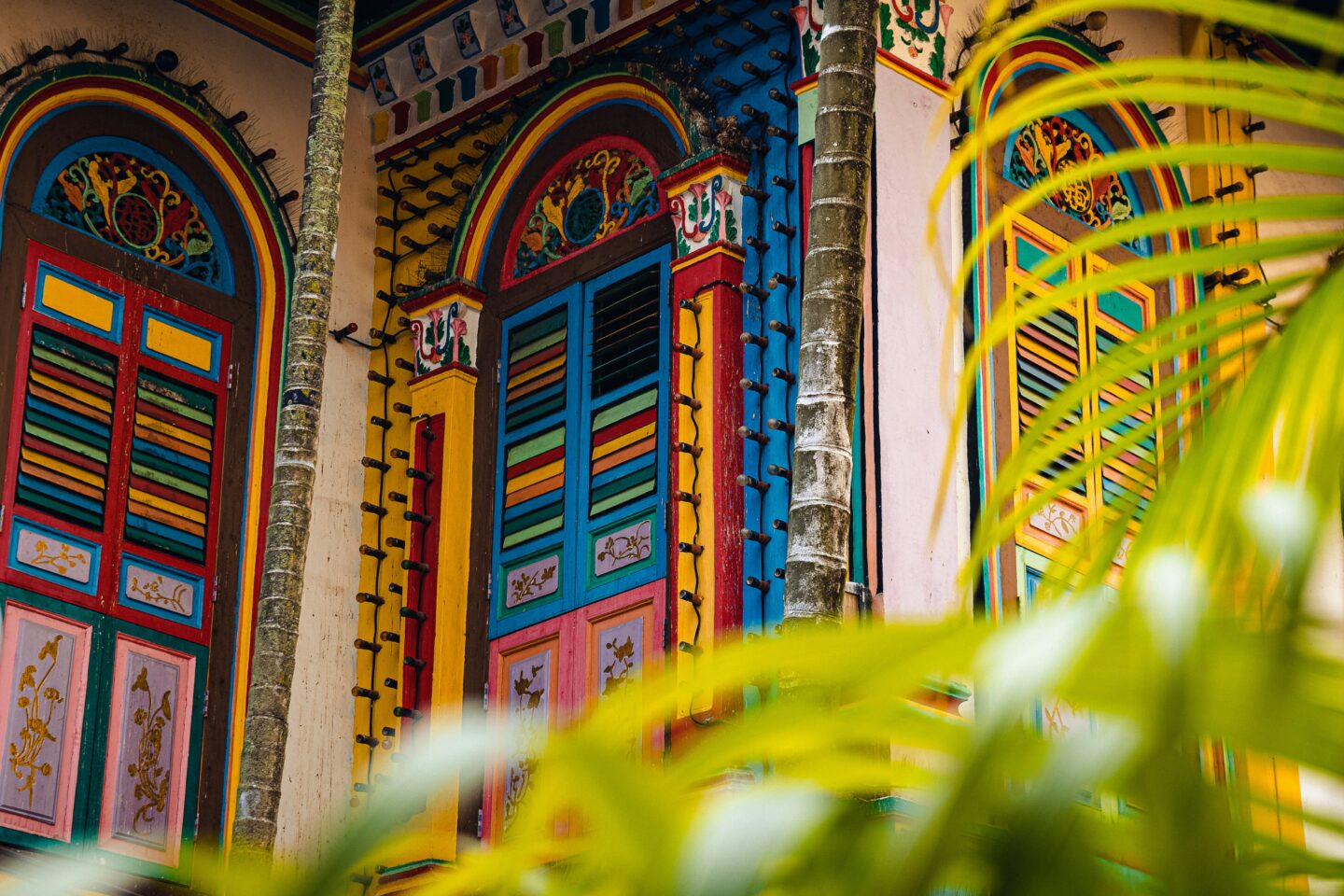
Here’s the one you will almost certainly see on Instagram. Tan Teng Niah House is the ridiculously colourful two-storey house tucked off Serangoon Road on Kerbau Road.
It was built in 1900 and is one of the neighbourhood’s best-known surviving Chinese villas. Its rainbow-coloured exterior makes it an obvious photography stop, but its presence also tells you something interesting about Little India.
This wasn’t historically an exclusively Indian neighbourhood. Chinese businesses and residents were part of the area’s story too, and Tan Teng Niah’s house is a reminder of that more complicated history. It’s also tiny. So don’t expect a sprawling heritage mansion. Just go and look, photograph it, appreciate the architecture and move on.
7. Campbell Lane & the Indian Heritage Centre
Don’t stick to Serangoon Road alone. Turn into Campbell Lane, where you’ll find a mix of restaurants, shops, heritage businesses and the Indian Heritage Centre, with plenty of colour and activity along the way.
What I find particularly interesting here is how much of Little India’s old commercial life is still part of the present-day neighbourhood. The National Heritage Board’s heritage-business listings include businesses that have been around for decades. Jothi Store & Flower Shop, for instance, started here in 1960 as a small provision shop and gradually grew into a destination for flowers, religious items and Indian cultural products.
If you’ve ever wondered how Little India came to look and feel the way it does, this is where I’d spend some time. The Indian Heritage Centre traces the history and culture of Singapore’s Indian community through its exhibitions and collections, giving you some context for everything you’re seeing outside.
The centre is open Tuesday to Sunday, 10am to 6pm, with last admission at 5.30pm, and is closed on Mondays. It also makes for a very welcome air-conditioned break when Singapore’s heat starts getting to you.
8. Go shopping – even if you don’t think you want to
Little India is dangerous territory for anyone who enjoys coming home with “just one thing.”
There are sari and textile shops, jewellery stores, spice shops, sweet shops, beauty stores, religious goods, Indian groceries and an impressive number of things you didn’t know you needed.
Little India Arcade
This cluster of conserved shophouses is a good place to browse for textiles, jewellery, souvenirs, sweets and other Indian goods. The buildings date back to the early 20th century and were conserved as part of the area’s heritage.
Mustafa Centre
I shopped here a lot during my time in Singapore. Mustafa is less “cute little heritage shop” and more “how is this building still getting larger?” It’s a massive department store open 24 hours, selling everything from groceries and jewellery to electronics, cosmetics and household goods.
You don’t have to go there. But if you’re the sort of person who enjoys wandering around supermarkets abroad – and I absolutely am — give yourself some time. It is an experience.
9. Eat your way through Little India
This is the section where you should arrive hungry. Little India is one of the best places in Singapore to eat Indian food, but I’d resist reducing it to one cuisine.
There are South Indian vegetarian restaurants, Tamil food, Indian-Muslim food, North Indian restaurants, biryani specialists, banana-leaf meals, sweets, snacks and plenty of regional variations. And because the neighbourhood is home to a real community, rather than existing solely for visitors, you get food at different price points.
Start with a dosa or thosai
A crisp masala thosai with chutneys and sambar is one of the easiest ways into Little India’s food scene. It’s inexpensive, filling and particularly good for breakfast.
Try biryani
Biryani is everywhere here, and for good reason. Look for both chicken and mutton versions and pay attention to the accompaniments — dalcha, pickle, raita or other sides depending on where you eat.
Bismillah Biryani, on Dunlop Street, is one of the area’s established names and has been recognised repeatedly with a Michelin Bib Gourmand. Visit Singapore currently lists it among Little India’s notable food stops.
Eat banana-leaf rice
This is one of the experiences I’d actively seek out if you’ve never done it before. Rice arrives on a banana leaf alongside vegetables, curries, papadum and accompaniments, with more gravy and rice often available depending on the restaurant. You can try it at Gandhi Restaurant on Chander Road, and yes, you can eat with your hands.
Try Indian rojak
Indian rojak is very different from the fruit-based rojak you’ll find elsewhere in Singapore. Here, you’ll get things like fried dough, potatoes, tofu, eggs and seafood, usually served with a sweet-spicy sauce. It’s messy and it’s delicious.. And it is another example of how Indian food in Singapore has developed its own local identity. You don’t find this in India!
Don’t ignore the sweets
Little India is also a good place to look for Indian sweets and snacks. You’ll find colourful boxes of mithai, jalebi, ladoos and other treats in shops around the precinct. This is where buying “a small box for later” becomes an entirely theoretical concept.
Where you should eat in Little India
Rather than give you a giant list of 25 restaurants – which will inevitably contain places that change, close or disappoint by the time you read it – I’d divide Little India food into experiences.
For hawker-style food
Head to Tekka Centre.
For South Indian vegetarian food
Look at longstanding names such as Komala Vilas, which has been serving the neighbourhood since 1947. The National Heritage Board lists it as a heritage business and notes its long-running recipes and culinary workshops.
For banana-leaf food
Look around Chander Road and Race Course Road. Gandhi Restaurant is one of the longstanding names here and is currently listed by the National Heritage Board as a heritage business.
For fish head curry
Muthu’s Curry on Race Course Road is the obvious heritage name, and it remains a Michelin Bib Gourmand-listed restaurant.
For biryani
Look at Bismillah Biryani and the many biryani stalls around Tekka. But don’t take “best biryani in Little India” lists too seriously. This is one of those neighbourhoods where local opinion is very divided, stalls change, and a recommendation from three years ago may not tell you much about lunch today.
Little India Singapore at night
Little India changes after dark. The shops and restaurants stay busy, people come in for dinner, and the neighbourhood’s late-night side becomes more apparent. Some businesses stay open very late, and Mustafa Centre is open 24 hours. If you’re staying in Singapore for several days, I’d actually consider returning in the evening rather than trying to squeeze everything into one daytime visit. It feels different.
And if you’re visiting during Diwali, expect a completely different level of activity, with lights, decorations and crowds transforming the area. The festival typically falls in October or November, depending on the year.
When is the best time to visit Little India?
For a comfortable walk, I’d go in the morning.
You’ll get:
- cooler temperatures
- the market at Tekka in full swing
- breakfast options
- flower shops and food businesses opening
- better light for photographs
- less exhaustion before the Singapore heat kicks in
If food is your priority, late morning into lunch works well.
If you want the neighbourhood atmosphere, go later in the afternoon and stay into the evening. I’d avoid the hottest part of the afternoon if you can. Singapore is hot and humid, and Little India is dense and largely explored on foot, so wandering around at 2pm isn’t my idea of fun.
How long do you need in Little India?
1 hour is enough for:
- Serangoon Road
- Sri Veeramakaliamman Temple
- Tan Teng Niah House
- a quick look at Tekka
You’ll see it but you won’t really experience it.
2-3 hours is enough for
Walking around, eating at Tekka, seeing the temples and some shopping.
4–5 hours is enough for
- Tekka Centre
- breakfast/lunch
- temples
- heritage sites
- Indian Heritage Centre
- shopping
- wandering down the side streets
- a second snack because you are in Little India and apparently have no self-control
A simple Little India walking route
If you don’t want to spend half your holiday following a Google Map around, do this:
Little India MRT → Tekka Centre → Serangoon Road → Sri Veeramakaliamman Temple → Little India Arcade → Campbell Lane → Indian Heritage Centre → Tan Teng Niah House → Race Course Road → Mustafa Centre
You can eat along the way.

What to buy in Little India
If you’re looking for souvenirs that don’t scream I bought this at the airport, Little India is a much better bet.
Look for:
- Indian sweets
- spices and masala blends
- tea
- incense
- traditional textiles
- small brass items
- jewellery
- beauty products
- religious items
- snacks and packaged food
If you’re buying spices or food products, check Singapore’s current customs and import rules before packing them into your suitcase. And if you’re buying clothes, remember that Singapore is not necessarily the cheapest place to buy everything just because you’re in a neighbourhood known for textiles. Browse first, then buy.
Is Little India worth visiting in Singapore?
Yes. But I’d put a small asterisk beside that answer.
Don’t go expecting a manicured heritage precinct where every building is spotless, every shopfront is photogenic and every restaurant has been selected by a committee. Little India is busier and messier than that.
Some streets are crowded. The pavements can be awkward. The neighbourhood can feel chaotic compared with Singapore’s more polished attractions. That’s because you’re not visiting a replica of an Indian neighbourhood. You’re walking through a part of Singapore where an Indian community has built businesses, places of worship, restaurants and cultural institutions over generations – and where those things are still being used.
You’ll see flower makers, spice merchants, restaurants, textile businesses and meat suppliers continue to operate here, some with histories stretching back decades. And then, five minutes later, you’ll be standing outside a contemporary cafe or looking at a new mural. Old and new, often within the same block.
Is Little India Singapore worth visiting if I’m Indian?
Yes – but perhaps for different reasons. If you’re Indian, you’re unlikely to be blown away by the existence of dosa or biryani. The interesting part is seeing how Indian food, religion, language, architecture and commerce have evolved within Singapore’s multicultural setting. And if you’re travelling with non-Indian friends, Little India is an excellent place to introduce them to foods and cultural experiences they may not otherwise encounter.
Is Little India Singapore worth visiting if I don’t eat Indian food?
Also yes. The temples, architecture, markets, heritage businesses, street art and shopping are enough to justify a visit. But, still eat something!
Can you visit Little India and Chinatown on the same day?
Absolutely. They’re close enough to combine, particularly if you’re building your Singapore itinerary around neighbourhoods rather than attractions.
You can easily do Little India in the morning, have lunch there and head towards Chinatown afterwards.
